
On Mesopotamia
A #LitReview Essay

From Roux to Podany: How Mesopotamia Became Narratable
Ancient Mesopotamia has never been an easy subject to hold still. Like the land itself between the Tigris and the Euphrates, it has always been an ever-shifting current of languages, peoples, families, city-states, and empires. Mesopotamia, as an idea operating in twenty-first-century historical imagination, is itself a modern scholarly construction. It emerged in the nineteenth century from the colonial peripheries of French, German, and British empires, as archaeologists and imperial agents sifted through ruins and clay tablets thousands of miles from their European capitals. The terms they created as they began interpreting these artifacts—Sumer, Akkad, Babylonia, Assyria, Iraq, Fertile Crescent, Near East—would have most likely been alien concepts and identities to the peoples that actually resided in the civilizations that stood there autonomously for nearly 4,000 years, from approximately 3500 BCE to the Achaemenid Persian conquest in the mid-6th century BCE. In many ways, Mesopotamia is simply the synthetic intellectual framework by which the modern Western imperial forces that created the equally synthetic idea of a Middle East* go about considering its ancient past. The historiography of Mesopotamia is therefore reflective of these complexities, and of its ultimate consumer—with often overlapping scholarly traditions of anthropology, archaeology, political science, religious studies, urban studies, economics, and climate studies synthesized into digestible, public-facing narratives for a college-educated middle or upper-class Western reader. I both describe and implicate myself in that sentence.
*Stay tuned for Wednesday’s #LeaderReads essay and reviews as we explore that term.
With definitions and self-definitions established, my own self-study of Mesopotamian history began years ago as an effort to provide geohistorical context for my tour in the Iraq War in the late 2000s, an experience that found an innocent Kentucky boy such as myself changing his socks under the distant watch of ziggurats. In that process, four works have been especially anchoring: Georges Roux’s Ancient Iraq (1964/1992), Gwendolyn Leick’s Mesopotamia: The Invention of the City (2001), Paul Kriwaczek’s Babylon: Mesopotamia and the Birth of Civilization (2010), and Amanda H. Podany’s Weavers, Scribes, and Kings (2022). These books are useful precisely because they are not narrowly technical monographs, but synthetic works written for students and educated general readers. Read together, they reveal not only what scholars have known about Mesopotamia over the last three-quarters of a century, but also how Mesopotamia has been made narratable across different historiographical moments. Roux provides a classic mid-20th century civilizational survey that makes ancient Iraq coherent as a civilizational whole; Leick embraces a late-twentieth-century urban focus that relocates that civilization in the city; Kriwaczek revives the grand narrative of civilization for twenty-first-century readers; and Podany breaks that grand narrative (generated produced by Euro-American, male-dominated Orientalist scholarship) open by returning to named, ordinary Mesopotamian people preserved unevenly in the archive. Together, they show how Mesopotamia has moved in public history from monument to city, from king to household, and from origin story to contested, all too human world.
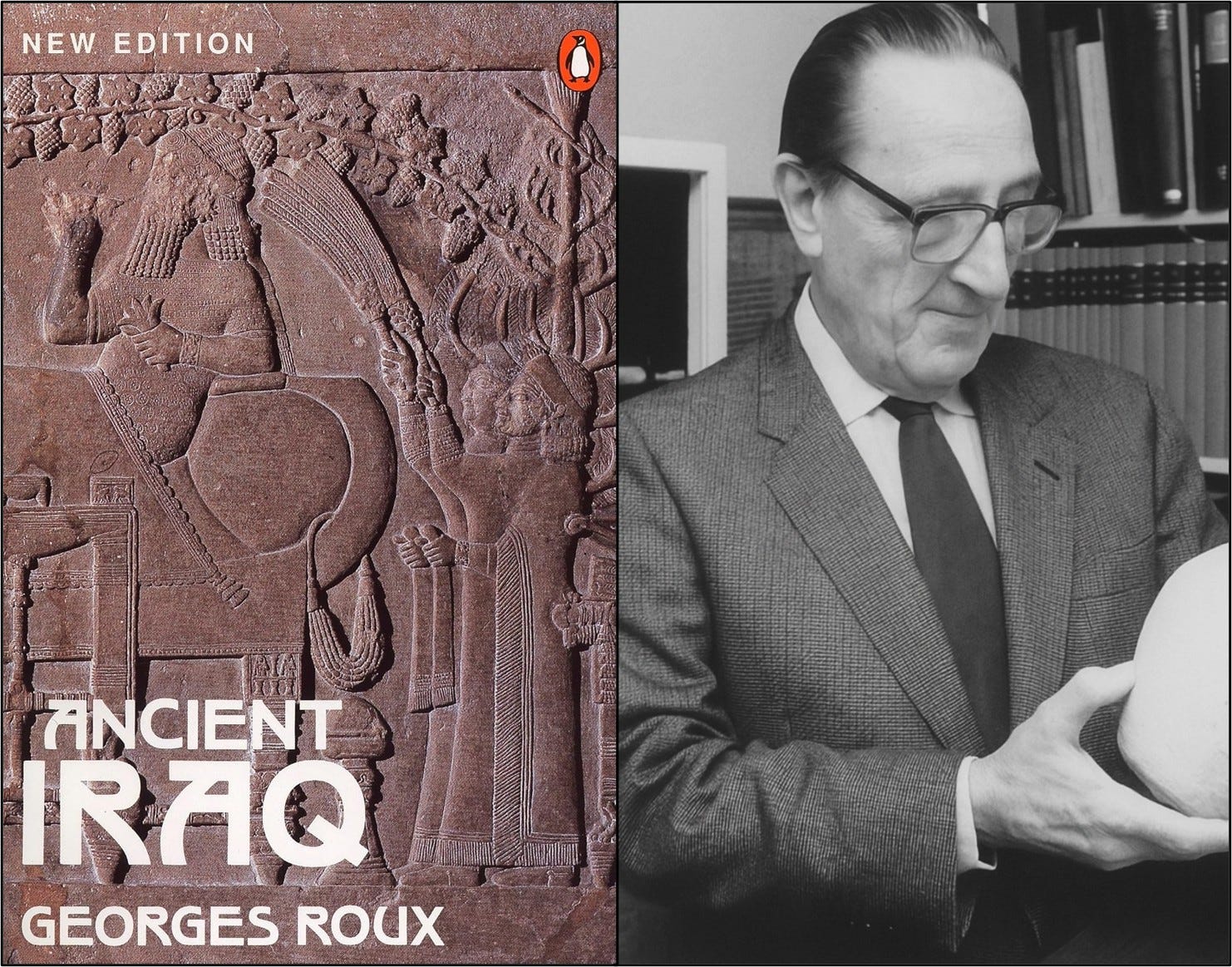
Ancient Iraq by Georges Roux (1964)
Ancient Iraq belongs to the classic tradition of the comprehensive civilizational survey. First published in English in 1964 and substantially revised through its third edition in 1992, the book was written by Georges Roux, an elegant, deeply educated French physician with formal training in Orientalism and long experience in the Middle East through his work with the British Iraq Petroleum Company. Roux, my first literary interaction with Mesopotamia, wrote as an informed popular historian rather than as a narrow specialist in Assyriology, the study of ancient Mesopotamian languages, texts, and cultures, especially cuneiform. His intended audience was explicitly “laymen and students,” and the book aimed to bridge the gap between specialist scholarship and accessible historical narrative. Reading Roux is to feel oneself stepping back into a more Indiana Jones period in the early and mid-20th century Middle East, with British and French archaeologists sounding dig sites with pickaxes in perfectly tailored wool suits and ties. This is not to say his work is not serious or seminal—Roux stands firmly alongside other foundational synthesizers who helped establish Mesopotamia as a coherent subject of historical inquiry rather than merely a collection of excavated sites or hard-to-decipher texts (Kramer, 1963; Oppenheim, 1977; Roux, 1992; Saggs, 2000; Van De Mieroop, 2016).
The great strength of Ancient Iraq is its breadth. Roux organizes Mesopotamian history through a largely chronological and political framework, moving from paleolithic prehistory c. 10000 BCE to the eventual “death” of Mesopotamian civilization as cuneiform disappears from historical memory in the late 1st century AD. Yet he does not write only political history. He integrates archaeology, geography, religion, law, literature, science, technology, and daily life into one continuous account. Roux’s prose is lucid, brisk, vivid (beautiful at times), sometimes even journalistic in the best sense: he makes the ancient world legible without reducing it to historical trivia. Roux’s central interpretive move is to treat Mesopotamia as a coherent geographical and civilizational unit whose Sumerian, Akkadian, Babylonian, and Assyrian phases share deep continuities.
That emphasis on continuity, however, is potentially both the book’s power and its limitation. Roux’s Mesopotamia presents a civilizational unity that makes the subject intelligible to newcomers, but it can also smooth over ruptures, regional diversity, and social complexity. [Spoiler alert: what we now know as the “Middle East” never was, is not, nor ever will be a monoculture]. Older survey traditions that informed the Assyriologists and Egyptologists of Roux’s era often privileged dynasties, rulers, campaigns, and state formations. Roux does not ignore society or culture, but his structure can sometimes harden into sequences of kings and conflicts. Later scholarship has also revised many particulars through new excavations uncovering newly published tablets now curated with computer-assisted research. As Roux himself recognized in his later editions, Mesopotamian studies were (and still are) changing quickly. His book therefore now reads best not as the final word, but as a landmark in synthesis: a classic macro-history whose greatest value lies in its ability to make Mesopotamia visible as a civilizational whole.
This role becomes even clearer when Roux is placed beside late Austrian American Assyriologist and Professor of Oriental Studies at the University of Chicago’s renowned Oriental Institute, Adolf Leo Oppenheim’s Ancient Mesopotamia: Portrait of a Dead Civilization. Oppenheim’s work, revised in 1977, offered a more thematic and anthropological portrait based on a deeper (probably then best-in-the-world) engagement with cuneiform texts. Rather than presenting a straightforward chronological narrative, Oppenheim explored urbanism, economy, literature, religion, psychology, medicine, science, and social organization as windows into lived culture (Oppenheim, 1977). Roux and Oppenheim therefore represent complementary strands of foundational Mesopotamian historiography: Roux provides narrative continuity; Oppenheim models Assyriology as a cultural interpretation. Together they mark a mid-to-late twentieth-century moment in which scholars and serious popularizers sought to make Mesopotamia (as well as Ancient Egypt) intellectually whole and intellectually accessible.
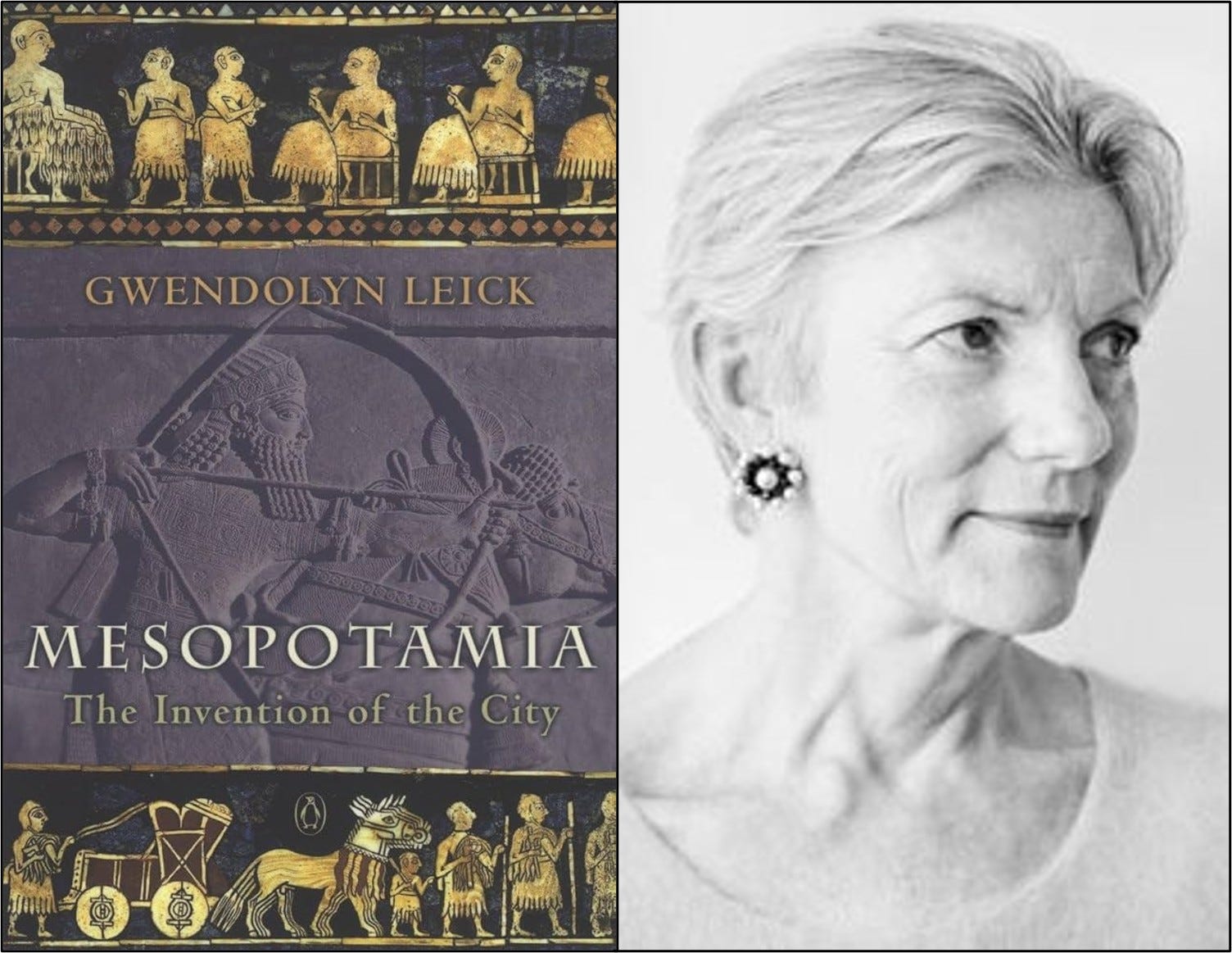
Mesopotamia: The Invention of the City by ‘Gwendolyn Leick’ (2001)
If Roux’s Mesopotamia is a civilization unfolding through time, Gwendolyn Leick’s Mesopotamia is a civilization centered spatially and socially through the city. Mesopotamia: The Invention of the City, published in 2001, represents a different historiographical sensibility. Leick, an Austrian-born British historian, trained Assyriologist, and three-time Olympic weightlifting champion at age 52 (I mean, why not?) writes for educated general readers and students similar to Roux, but her method is explicitly interdisciplinary from the outset. She brings together archaeology, architecture, cuneiform texts, myth, and anthropological interpretation, but all at the service of ten city-centered chapters that move broadly from Eridu, the first of all cities whose simple foundations were laid on the Edenic, virgin soil of southern Iraq, to the layered, complex urban grandeur of Babylon.
Leick’s book belongs to the larger archaeological and urban turn in Mesopotamian studies in the late 20th and early 21st centuries. Archaeology by that time had moved beyond older culture-historical description toward what are known as processual, post-processual, ecological, and comparative approaches, methodologies and theoretical frameworks that shifted the discipline from merely describing artifacts to using the scientific method to explain how and why past cultures evolved (Matthews, 2003; Wilkinson, 2000; Algaze, 2008; Emberling, 2015). Leick’s work participates in this same conversation, but with a more literary and urban touch.
Her core argument is that Mesopotamia’s greatest and most enduring innovation was not simply writing, bureaucracy, or kingship, but the city itself. For Leick, the city (any city) is heterogeneous, sacred, socially productive, and historically durable. It makes possible cooperation, agglomeration (a powerful economic term), specialization, long-distance exchange, collective memory, and resilient political identities. She also repeatedly links urban emergence to the opportunities and dangers of southern Mesopotamia’s flood plain environment: fertile soils, unstable rivers, irrigation demands, ecological risk, and the need for a constantly negotiated coexistence with one another. In doing so, she turns the city from a backdrop into the central historical actor.
Leick’s most important contribution is that she refuses to reduce cities to economics alone. Temples, myths, ritual landscapes, and literary memories are not ornamental additions placed atop a “real” material base. They are the brick and mortar (no pun) of urban life. The city is an administrative and economic space, certainly, but it is also a deeply sacred and imaginative one, teeming with religion and art like Whitman’s New York or Joyce’s Dublin. This distinguishes Leick from more narrow, basic function accounts of early urbanism. Her Mesopotamian city is a built environment, a vibrant ritual landscape, a memory system that exists in space, as well as a political form.
At the same time, Leick’s interpretive elegance does invite debate. Some readers may question the weight she gives to ritual symbolism in early urbanism (which, I admit, is quite often). The relative primacy she assigns to the city-state over their place in larger territorial empires (of which five out of ten of the cities she analyzes, Akkad, Ur, Asur, Nineveh, and Babylon, all served as political or cultural capitals) is also open to counterargument, as is the degree to which Mesopotamia should be privileged as the paradigmatic cradle of urban civilization over say Egypt to the west, or the Indus Valley to the east, both of which developed complex urban forms in roughly comparable cultural horizons. Archeologist and professor of Anthropology at Binghamton University Susan Pollock’s Ancient Mesopotamia: The Eden that Never Was offers an especially useful general counterpoint to Leick, emphasizing that early urbanism did not emerge without any social costs, including the ways inequality, exploitation, and coercion (present in any city) were baked into civilization’s socioeconomic clay from the beginning in Mesopotamia (Pollock, 1999). Where Leick stresses the city’s creativity and symbolic richness, Pollock reminds us that early cities also produced still very extant hierarchy and domination. Read together, they show how the historiography of Mesopotamian urbanism has moved beyond celebration toward caution.
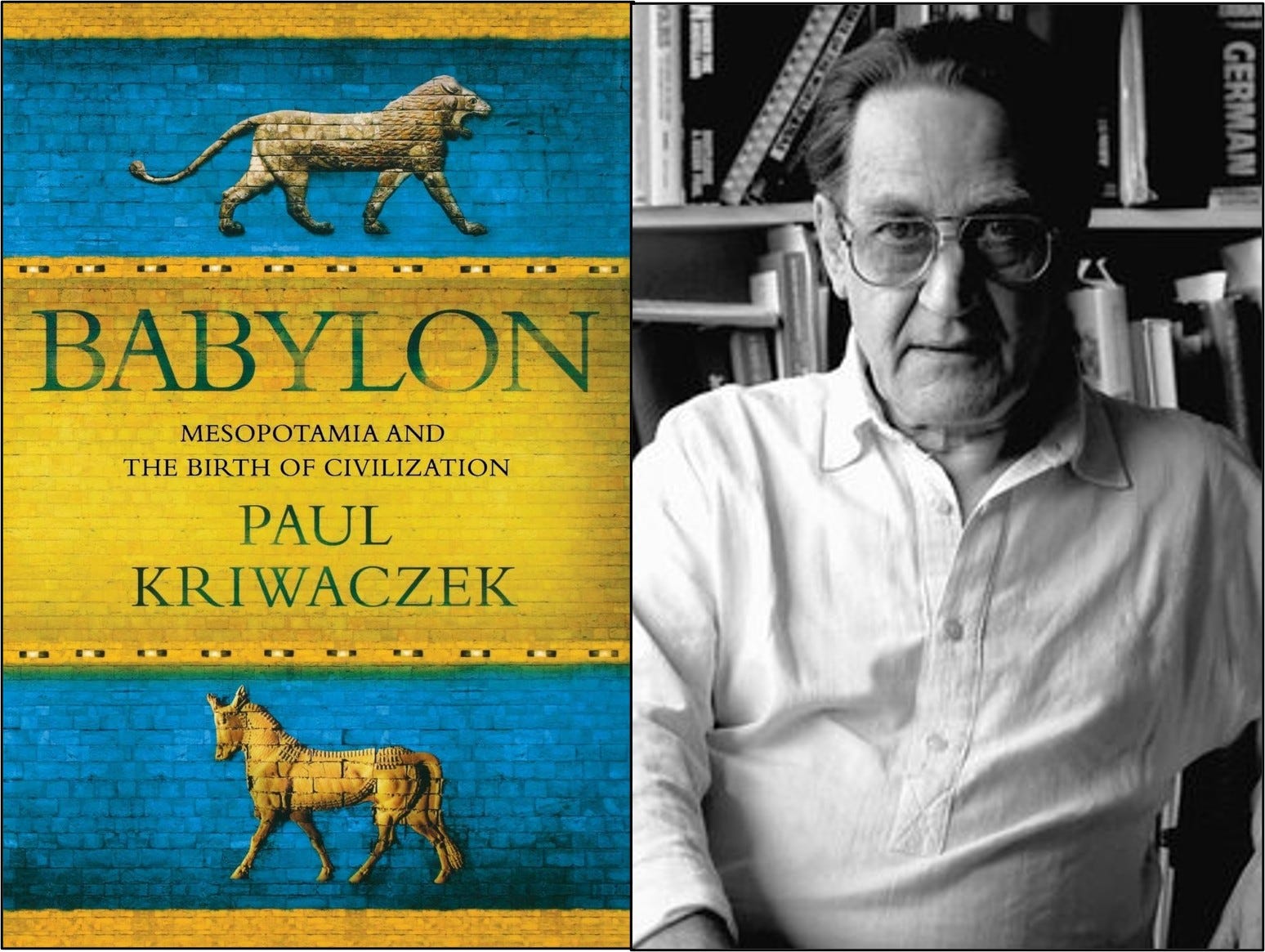
Mesopotamia and the Birth of Civilization by Paul Kriwaczek’s (2012)
Paul Kriwaczek’s Babylon: Mesopotamia and the Birth of Civilization occupies a related but distinct position compared to Roux or Leick. Published in 2010, with a U.S. edition in 2012, it is a sweeping narrative history, but one written by a journalist and BBC World Service specialist rather than a trained Assyriologist. That background shapes the book’s intended audience, prose style, and interpretive method. Kriwaczek writes with energy, vivid analogy, and a strong instinct for contemporary relevance and readership. His audience is the educated general reader, but his ambition is clearly to make Mesopotamia not only accessible to them, but paradoxically urgent to their need to make sense of the institutions of modern civilization [Second spoiler alert: they haven’t changed that much].
The book’s central project is to narrate the emergence of civilization in the Fertile Crescent, especially in southern Mesopotamia, and Kriwaczek emphasizes agriculture, cities, writing, centralized governance, law, bureaucracy, and cultural memory as features that first coalesced in Mesopotamia in historically consequential ways. His narrative moves from Neolithic settlements around 8000 BCE to the Persian conquest in the sixth century BCE somewhat parallel to Roux, but the book pauses over familiar conceptual thresholds clearly selected for Anglo-American minds formed in primary and secondary school social studies classes and Sunday Bible studies, specifically the development of cuneiform and the cultural memory of the Flood. However non-academically they may sometimes be treated, these moments become symbolic dividing lines for Kriwaczek between prehistory and history.
Historiographically, Kriwaczek revives Roux’s “big civilizational story” for accessibility purposes long after that story had already been complicated by archaeology, environmental history, social theory, and critiques of state power. His book draws on archaeological findings, mythological texts such as Atrahasis and The Epic of Gilgamesh, as well as comparative historical analogies. He frequently juxtaposes ancient Mesopotamian institutions with modern phenomena such as bureaucracy, planned economies, cults of personality, inequality, and state violence. This makes Babylon lively and memorable, but also methodologically risky. Analogy can illuminate ancient experience, but it can also potentially flatten very salient historical differences similar to Roux.
Kriwaczek’s emphasis on Mesopotamia as the “birth” of civilization is both popular, compelling, but also contestable. On one hand, the claim captures something real: Mesopotamia was one of the earliest regions where writing, urbanism, bureaucracy, monumental institutions, and territorial states emerged in a dense and mutually reinforcing configuration. On the other hand, “first civilization” narratives can, as critiqued in Leick’s urbanism, risk understating parallel developments in Egypt, the Indus Valley, and even China. They can also make Mesopotamian history seem more linear and unified than it was (Van De Mieroop, 2016).
Kriwaczek’s value, then, lies less in technical novelty than in interpretive reach. He makes Mesopotamia matter to readers who might otherwise see it as remote. He invites them to recognize bureaucracy, literacy, inequality, state power, and cultural memory as ancient human problems still raging in the here and now rather than categories at the British Museum. His weakness is the same as his strength: his rhetorical comparisons can outrun the nuance of specialist debate required for a complete understanding. Still, Babylon performs an important public-historical function. It shows that Mesopotamia is not only an ancient subject but a continuing mirror in which modern societies examine their own institutional habits.
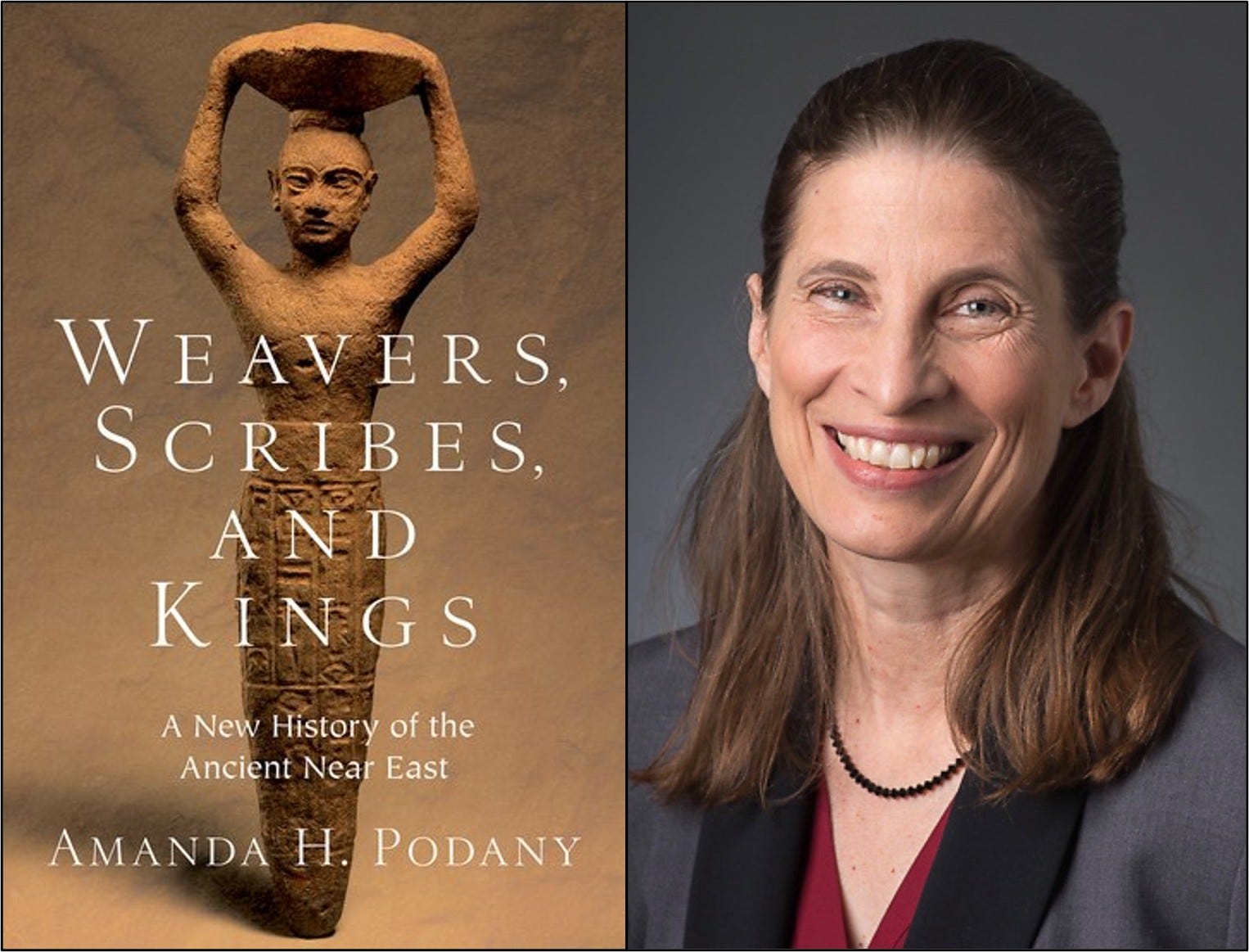
Weavers, Scribes, and Kings: A New History of the Ancient Near East by Amanda H. Podany (2022)
Amanda H. Podany’s Weavers, Scribes, and Kings: A New History of the Ancient Near East, published in 2022, represents the most recent historiographical moment among the four books we’ve reviewed. Podany, a historian of Mesopotamia and Syria and Professor Emerita of History at Cal Poly Pomona, presents a broad synthesis for students and educated general readers, but its architecture differs sharply from Roux’s civilizational macro-history or Kriwaczek’s civilizational epic—Podany organizes roughly 3,000 years of ancient Near Eastern history around named individuals: not only the kings and queens inscribed in the royal lineages, but also weavers, scribes, merchants, soldiers, musicians, enslaved people, household actors, even brewers [Third spoiler alert: Mesopotamians, hardworking farmers and craftsmen in the main, LOVED a good beer].
Where Roux gives the reader a civilizational map, Podany gives the reader fragments of lives—partial, uneven, institutionally preserved, but recognizably human. Podany’s book is not merely social history in the abstract; it is a people-centered history built from texts, archaeology, and art produced within cuneiform-literate cultures, some of whom extended outside the bounds of the Tigris and Euphrates. She treats ancient Near Eastern history as a “weathered mosaic,” a phrase that captures the methodological humility of more recent Mesopotamia scholarship, and she is open with the reader that the archaeological evidence that underwrites most Assyriology past or present is abundant but also uneven. Some people appear in the archaeological record because they were powerful; others appear because they were caught in the paperwork of palaces, temples, households, lawsuits, contracts, letters, or diplomatic exchanges. Podany’s method therefore remains both intimate and cautious. She uses the archive to recover individual lives while reminding the reader that the archive itself was produced by institutions of power.
Podany’s central argument is that the ancient Near East was not merely a theater of kings, wars, and imperial expansion. It was a connected human world shaped by labor, family strategy, scribal practice, religion, law, diplomacy, household economics, and long-distance exchange. This emphasis reflects larger developments in the field. Director of the British School of Archaeology in Iraq, J. L. Postgate’s Early Mesopotamia had already demonstrated the importance of society and economy in understanding early Mesopotamian institutions (Postgate, 1992). Studies of Mesopotamian religion and myth had also deepened scholarly understanding of their symbolic worlds (Black & Green, 1992; Bottéro, 1995; Lambert, 2016; Leick, 2002). Similarly, studies on Mesopotamian science, medicine, mathematics, and intellectual life had shown that their civilization cannot be reduced to kingship and conquest alone (Boyer, 1991; Stol, 1993). Podany’s greatest contribution is to gather this newer, broader, scholarly world into a humane, contemporary narrative focused on real persons rather than academic abstractions, where uncertainty about historical methods and evidence is part of the historical conversation.
Conclusion
Taken together, Roux, Leick, Kriwaczek, and Podany map a useful arc in the public-historiography of Mesopotamia. Roux represents the classic civilizational survey: chronological, synthetic, politically anchored, and committed to Mesopotamian continuity. Leick shifts the center of analysis from civilization as a sequence in time to the city as a social, ritual, architectural, and ecological form. Kriwaczek reanimates Roux’s grand narrative of civilization for modern readers, emphasizing Mesopotamia’s continuing relevance to bureaucracy, state power, inequality, and cultural memory. Podany brings the field into a more recent mode: connected, evidentiary, humane, attentive to ordinary lives, and openly aware of the fragmentary archive upon which every work above it is built. Read together, these books are not competitors in a winner-take-all historiographical contest. They are better understood stratigraphically, that is, in the same manner as the layers of civilizational history (some 40 feet deep) in your average Mesopotamian dig site. Roux provides the foundational layer: the great chronological sweep of ancient Iraq. Leick excavates the urban form within that sweep. Kriwaczek turns the story outward, asking why Mesopotamia still matters to the modern political imagination. Podany returns us to the archive and to the people whose lives made the institutions real, and who walked along the walls of the ancient cities when they were not dusty ruins, but loud, vibrant, and teeming with the human experience.
As documented, that arc mirrors broader changes in Mesopotamian studies itself. Early and mid-twentieth-century scholarship, shaped by Tolkien-style philology, excavation, art history, royal inscriptions, and literary texts, produced the powerful image of Mesopotamia (and Egypt…see next week’s #LitReview) as a “dead civilization” reconstructed from tablets, monuments, and ruins (Oppenheim, 1977). Later scholarship complicated that image through environmental history, economic analysis, anthropology, and critiques of hierarchy and exploitation (Algaze, 2008; Matthews, 2003; Pollock, 1999; Wilkinson, 2000). More recent work has pushed further still, integrating gender, labor, household life, microhistory, environmental instability, and comparative global history (Emberling, 2015; Podany, 2022; Van De Mieroop, 2016). Mesopotamia, then, is not merely what happened between the Tigris and Euphrates thousands of years ago. It is also the evolving set of questions modern scholars have learned to ask of mudbrick cities, broken tablets, unstable rivers, royal inscriptions, household contracts, myths, temples, and, at the very foundations, very recognizable human beings. The field of Assyriology truly has moved from civilization to city, from king to household, from monument to archive, from origin story to contested social process. Yet the older syntheses still matter because they gave the field its shape. The newer works matter because they remind us that no civilization, however ancient, was ever lived at the scale of abstraction. Civilizations are reconstructed by scholars, often millennia after the fact, and often to understand their own civilizations, but they were, are, and always will be lived by people.
References
Algaze, G. (2008). Ancient Mesopotamia at the dawn of civilization: The evolution of an urban landscape. University of Chicago Press.
Black, J., & Green, A. (1992). Gods, demons and symbols of ancient Mesopotamia: An illustrated dictionary. University of Texas Press.
Bottéro, J. (1995). Mesopotamia: Writing, reasoning, and the gods (Z. Bahrani & M. Van De Mieroop, Trans.). University of Chicago Press. Original work published 1987.
Boyer, C. B. (1991). A history of mathematics (2nd ed.). Wiley.
Emberling, G. (2015). Mesopotamian cities and urban process, 3500–1600 BCEE. In N. Yoffee (Ed.), The Cambridge world history: Volume 3, Early cities in comparative perspective, 4000 BCEE–1200 CE (pp. 253–278). Cambridge University Press.
Foster, B. R., & Foster, K. P. (2009). Civilizations of ancient Iraq. Princeton University Press.
Frankfort, H. (1970). The art and architecture of the ancient Orient (4th ed.). Penguin Books.
Kramer, S. N. (1963). The Sumerians: Their history, culture, and character. University of Chicago Press.
Kriwaczek, P. (2012). Babylon: Mesopotamia and the birth of civilization. Thomas Dunne Books. Original work published 2010.
Lambert, W. G. (2016). Ancient Mesopotamian religion and mythology: Selected essays. Mohr Siebeck.
Leick, G. (2001). Mesopotamia: The invention of the city. Penguin Books.
Leick, G. (2002). A dictionary of ancient Near Eastern mythology. Routledge.
Matthews, R. (2003). The archaeology of Mesopotamia: Theories and approaches. Routledge.
Oppenheim, A. L. (1977). Ancient Mesopotamia: Portrait of a dead civilization (Rev. ed., E. Reiner, Ed.). University of Chicago Press.
Podany, A. H. (2022). Weavers, scribes, and kings: A new history of the ancient Near East. Oxford University Press.
Pollock, S. (1999). Ancient Mesopotamia: The Eden that never was. Cambridge University Press.
Postgate, J. N. (1992). Early Mesopotamia: Society and economy at the dawn of history. Routledge.
Roux, G. (1992). Ancient Iraq (3rd ed.). Penguin Books. Original work published 1964.
Saggs, H. W. F. (2000). Babylonians. University of California Press.
Stol, M. (1993). Epilepsy in Babylonia. Styx Publications.
Van De Mieroop, M. (2016). A history of the ancient Near East, ca. 3000–323 BCE (3rd ed.). Wiley Blackwell.
Wilkinson, T. J. (2000). Regional approaches to Mesopotamian archaeology: The contribution of archaeological surveys. Journal of Archaeological Research, 8(3), 219–267.
This was a great read. It makes me wonder if Roux's "foundation" will ever be remade. Or is every scholarly take further up the 40-foot dig?